Gates of Olympus 2500: A Working Strategy
Gates of Olympus 2500 has no betting system that beats the math, but a real session plan still matters: budget caps, bet sizing, and stop limits built around a 96.52% RTP and a 25,000x ceiling.
Gates of Olympus 2500 doesn't bend to a strategy. Every spin is generated fresh, the base RTP sits at 96.52%, volatility is high, and a single round can pay out up to 25,000x your stake. What you can control is everything around the spin: the budget you bring, the bet size you choose, and the point at which you stop. This page walks through what stays in your hands and where the math takes over.
What a Strategy Can and Can't Do in Gates of Olympus 2500
The honest answer: there is no tactic that raises your odds on a spin. A random number generator produces each outcome, and the next result doesn't depend on the previous one, your bet size, or how long you've been playing. Pragmatic Play rates the slot as high volatility, which means quieter stretches between the occasional large payout, with both stretches and payouts arriving at random.
What you can actually plan is the session itself. That covers a budget of money you can genuinely afford to lose, a bet size within the $0.20 to $240 base range, a working knowledge of cascades and multipliers, a decision on whether to stay in the base game or switch to an Ante or Super Spin mode, and stop-loss and time limits set before the first spin. None of that brings a big payout any closer. What it does is cap how much you can lose and help you walk away on time. For a closer look at how the slot itself runs, see the Gates of Olympus 2500 review and its mechanics.
The trap is treating any of those levers as a way to influence outcomes: predicting when a Scatter will land, "warming up" the machine with empty spins, chasing past losses, or expecting multipliers to combine into a big score. A session that falls into that pattern usually looks the same: the bet doubles, modes get switched, and the spinning continues long after the limit was hit.
How a Winning Round Actually Plays
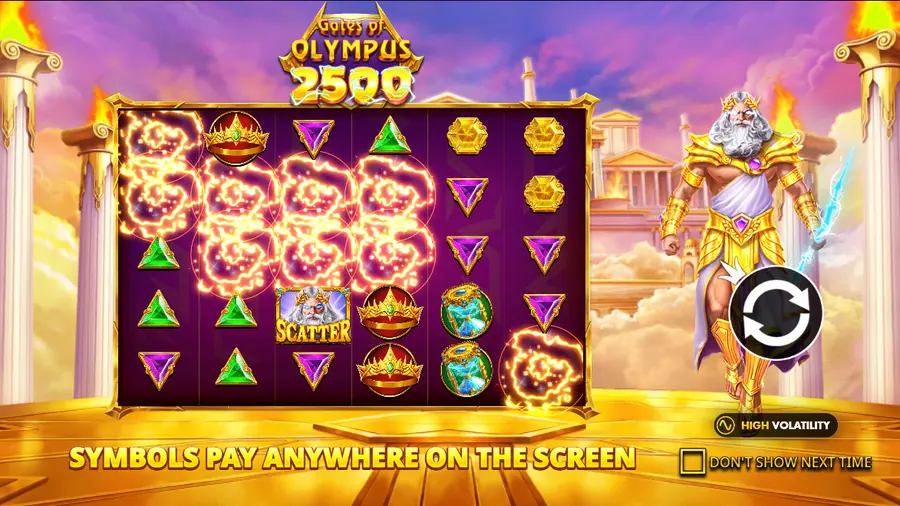
Symbols pay anywhere on the grid, and only the total count of matching symbols after all cascades matters. The threshold is 8 identical symbols, with the payout stepping up at 8-9, 10-11, and 12+. Green gem, for instance, pays 0.4x for 8-9, 0.9x for 10-11, and 4x for 12+. These are stake multipliers, not fixed dollar amounts: change the bet and the absolute numbers change with it.
When a cascade resolves, winning symbols disappear, the rest drop down, empty positions fill from above, and the chain continues as long as new matches appear. The rules don't cap how many cascades a single spin can produce, though long chains are rare. A Tumble of three or four drops doesn't make a fifth more likely, and a short chain in one spin doesn't raise the odds of a longer one in the next.
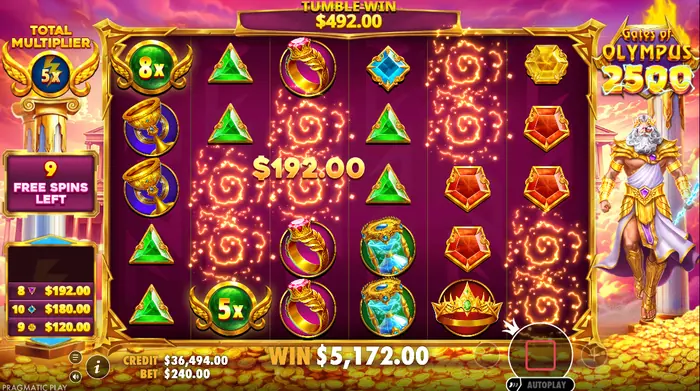
When the cascades in a spin finally end, every multiplier that landed in the chain sums together and applies to the spin's total payout. In the base game, multipliers only count when they actually appear, and accumulation restarts from zero with each new spin.
Combinations and Symbols
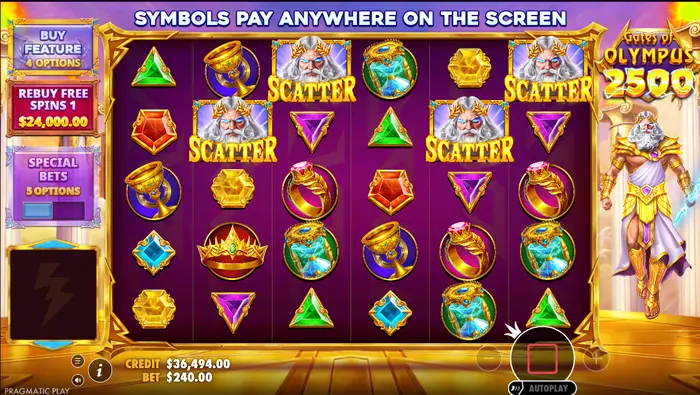
The paytable splits symbols into themed ones (crown, hourglass, ring, goblet) and five colored gems. The crown tops the regular set at 10x / 25x / 50x for 8-9 / 10-11 / 12+. Red gem gives 1x / 1.5x / 10x; blue sits at the bottom of the gem ladder with 0.25x / 0.75x / 2x.
Multipliers are a separate symbol type: winged orbs that carry a random value from the set 2x, 3x, 4x, 5x, 6x, 8x, 10x, 12x, 15x, 20x, 25x, 50x, 100x, 250x, 500x, 1000x, 1500x, 2000x, or 2500x. They appear at random in both the base game and free spins, and they're what turn a moderate cascade into a large payout when they show up.
One practical note about the in-game paytable: it shows values in dollars at the current bet. If a screenshot or table from the game is reprinted with those dollar values, the numbers will be wrong at any other bet size. Stake multipliers are the only version that holds up across bets.
Cascades and Individual Wins
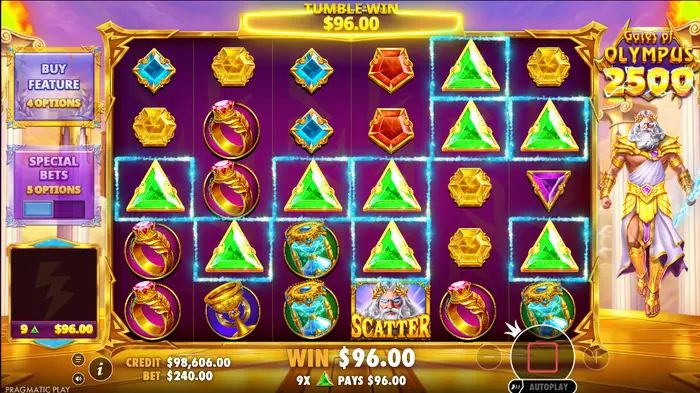
A Tumble is several sequential payouts within a single spin. The grid is first evaluated, winning symbols disappear, the rest fall, new ones drop in from above, and the cycle repeats as long as matches keep appearing. All wins from one cascade chain are summed, and the combined amount is multiplied by the total multiplier once the chain ends.
The number of drops in a round carries no information about the next one. Three or four cascades in a row doesn't make a fifth more likely, and a quiet spin doesn't make the next one louder. Each new cascade starts from zero.
One thing worth keeping in mind when planning a budget: in the base game the win is credited after all cascades in the spin are done, and in free spins it's credited after the full round ends. The counter on the screen climbs step by step, while the real credit arrives as one total.
High Volatility: How to Account for the Risk
High volatility in Gates of Olympus 2500 is a concrete thing. Between big moments, you can run through dozens of spins without a meaningful payout, and those moments themselves are random and irregular. The machine isn't "remembering" anything, and a quiet stretch isn't a sign that a bonus is close.
A player with a small budget risks burning through it before the slot ever shows a multiplier or triggers a bonus. That's why a session should be planned for the worst case: the entire budget gone without a big payout. High volatility isn't a cue to raise your bet.
Practical anchors for a session:
- Plan for 200-400 spins, not "one big hit."
- Don't raise the bet after a loss.
- Don't read a long run of empty spins as "due" for compensation.
- The 96.52% RTP is an average across a long stretch. In a short session, the spread can be anything.
Planning Budget and Session Length
A session budget is an amount whose loss wouldn't affect essential expenses: rent, food, loan payments, savings. Anything beyond that line shouldn't go into a slot. Set the figure before the first spin and don't go past it.
Then divide the budget by the bet size. With a $0.20 bet and a $40 budget, that's 200 spins. At $1 per spin, the same budget covers just 40 spins. The bigger the bet, the faster the bankroll burns and the less time you have to wait out a bonus or a large multiplier.
It also helps to set:
- a loss limit (say, 30-50% of the budget) at which the session stops;
- a time limit (say, 30-60 minutes) after which you walk away regardless of the result;
- a win target, a fixed sum at which the session also ends. Pushing on "while it's going" in a high-volatility slot means giving the win back.
Why Previous Spins Don't Predict Anything
The most common slot myth is the idea of a "hot" or "cold" machine. In reality, every spin in Gates of Olympus 2500 is generated fresh, and the result doesn't depend on what landed a second ago. Ten empty spins in a row don't raise the odds of the next one being a winner, and a string of wins doesn't promise more.
The second mistake is "compensation." If a player has lost part of the budget, a feeling can creep in that the machine "owes" something back. It doesn't. The 96.52% RTP is a statistic across millions of spins, and in a short session anything is possible, including a zero.
The third trap is needing to "win it back" after a loss. That's a straight path to losing control and raising the bet under the influence of emotion.
The fourth is anchoring on someone else's big win. Screenshots showing large amounts in the base game and free spins are individual rare moments, and seeing one isn't an argument for raising your own bet or buying a bonus.
Choosing a Bet Size Without the "Right Number" Myth
There is no "correct" bet size in Gates of Olympus 2500. Bet size can't change the odds of symbols or bonuses landing; the RNG handles that. What bet size does change is how fast the budget burns and what an absolute payout looks like when a big cascade hits.
The logic is simple. Decide on a budget and an approximate number of spins for the session. Bet = budget ÷ number of spins. It's an anchor, and cascades can end earlier, leaving the balance dropping faster than expected.
For Gates of Olympus 2500, the stated bet range is $0.20 to $240 in the base game. In the Ante and Super Spin modes, the real cost per spin is higher because of the stake multiplier: Super Spin 1 multiplies the base bet by 20, Super Spin 2 by 250. Those modes change the round's structure (multiplier appearance, free-spins odds), not the probabilities, and they cost more.
| Mode | What it changes | Cost vs. base |
|---|---|---|
| Base game | Base RTP 96.52% | ×1 |
| Ante Bet 1 | Free-spin odds ×2 | ×1.25 |
| Ante Bet 2 | Free-spin odds ×8 | ×2.75 |
| Ante Bet 3 | Free-spin odds ×8, more Super FS 1 and FS 2 | ×5.5 |
| Super Spin 1 | Every spin has a multiplier, no free spins | ×20 |
| Super Spin 2 | Every spin has a 25x+ multiplier, no free spins | ×250 |
An important detail: Ante Bet modes lower RTP to 96.49%, while Super Spin and bonus buy come in at 96.50%. Across all modes, plain unenhanced play returns the most per unit bet.
Low, Medium, and High Bets
A low bet stretches the budget across more spins. The player has more chances to wait out a bonus or a large multiplier, but the absolute payouts stay modest. A crown for 12+ symbols at a $0.20 stake pays $10; at a $1 stake, $50. The same logic works in reverse: 200 spins at $0.20 is $40 lost, while 200 spins at $5 is $1,000.
A medium bet is a compromise between session length and potential payout size. A high bet sharply reduces the number of spins the budget covers. In a high-volatility slot, that's critical: it's entirely possible to never see a single big cascade.
Ante Bet and Super Spin modes raise the cost of each spin, so they're weighed against the same budget. Super Spin 2 at a $240 base stake is $60,000 for a single spin, the maximum bet in the game. At that size, the bankroll needs to be many times larger for the session to make sense.
Pausing and Controlling Spend
A useful skill is taking breaks before emotions start dictating decisions. The longer a session runs and the more the balance drops, the harder it is to stop. Limits set in advance help precisely because the decision gets made with a clear head.
In practice that looks like this: before launching the slot, lock in the budget, loss limit, and time limit, then either run autoplay with a set number of spins or play manually. When any limit is hit, the session ends, even if the bonus feels "almost there." Raising the bet to recover losses is the path to losing control.
If the platform offers limit features (daily cap, self-exclusion, session timer), turning them on ahead of time is a good move. For more on the specifics of real-money play, see the guide to playing for real stakes.
Multipliers: Real Potential, No Guarantee
Multipliers are the main source of big payouts in Gates of Olympus 2500. In the base game, they can land on any spin and in any cascade, taking a random value from 2x to 2500x. When the cascades in a spin end, all multiplier values that appeared in the chain are summed and applied to the spin's total payout.
The "2500" in the slot's name is the cap on a single multiplier symbol, not the cap on a round's payout. The maximum round win is 25,000x the stake. At a $1 bet that's $25,000; at $240, $6,000,000. Two different numbers that are easy to mix up: 2500x is the ceiling for one symbol, 25,000x is the ceiling for the whole round.
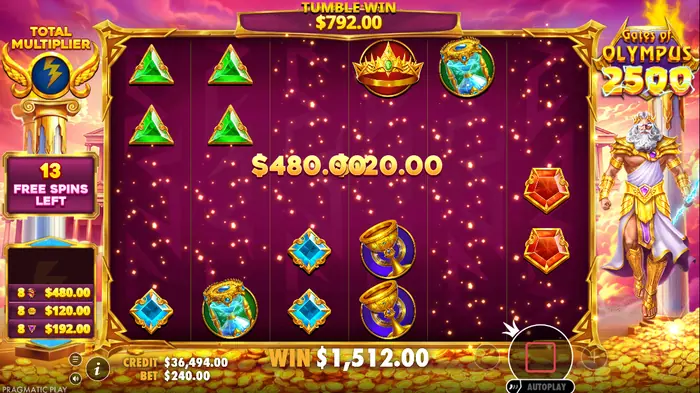
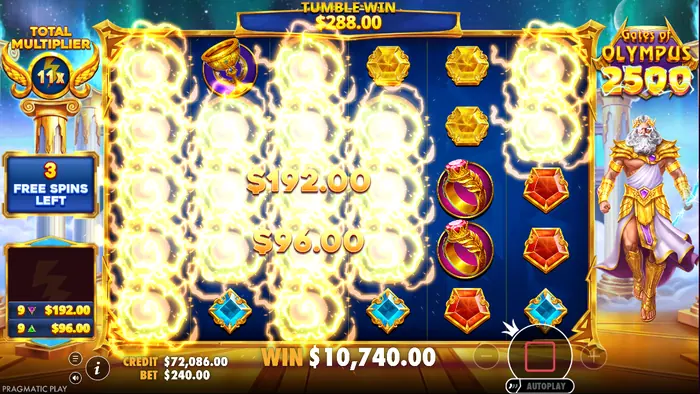
Screenshots showing big balances like $5,172, $10,740, or $36,494 are individual lucky runs. They show a payout is possible, but they don't represent a typical result and don't predict when the next one will land in your session.
Multipliers During a Cascade
In the base game, the multiplier applies to the entire cascade chain's payout, not to each drop individually. If one spin produces two multipliers of 5x and 3x, the chain's total multiplier is 8x, and 8x multiplies the sum of all cascade wins in that spin. If no multiplier landed during the chain, the payout goes through unmultiplied.
Several cascades in a row don't guarantee a big multiplier will appear in one of them. Multipliers are random, and their presence or absence in the current spin has nothing to do with how many cascades have already played. Watching a long Tumble chain and waiting for a multiplier is a habit the math doesn't reward.
Multiplier Progression in Free Spins
In free spins, the logic changes depending on the round type. In Free Spins 1 and Super Free Spins 1, a new multiplier's value is added to the total multiplier only on a winning spin. From then on, the total multiplier is applied to a payout only when a new multiplier lands on a winning spin.
In Free Spins 2 and Super Free Spins 2, the value is added to the total multiplier every time a multiplier symbol appears, regardless of whether the spin is a winner. The total multiplier applies to every win in the round. In the Super versions (Super Free Spins 1 and Super Free Spins 2), the minimum multiplier value is 10x, which raises the chain's potential ceiling. And that bonus costs more to buy.
Triggering free spins is random, and the wheel that picks the round type is just an animation. The type is decided beforehand, before the visual spin. That's worth knowing so the "intuition" before a Scatter doesn't get treated as a signal.
Free Spins and Bonus Buy
Free spins in Gates of Olympus 2500 can be reached two ways: randomly, when 4 or more Scatters land anywhere, or instantly, via the Buy Feature. In both cases, the round's outcome is random. Buying just skips the wait.
The round starts with 15 free spins, and the round type is chosen at random. 3 or more Scatters during any free-spin type award +5 extra spins. The round's max win is capped at 25,000x the stake. Once that threshold is reached, the round ends immediately.
Buying the bonus costs more than a regular spin and is tied to the base stake before any multipliers:
- Free Spins 1, 100x the base stake.
- Free Spins 2, 250x.
- Super Free Spins 1, 500x.
- Super Free Spins 2, 1250x.
That's a one-time large outlay, not an investment with an expected return. The buy's RTP is 96.50%, only a hair below the base 96.52%. Buy Feature availability depends on the operator and jurisdiction: in some regions, buying bonus rounds isn't offered at all.
How Scatter Triggers Free Spins
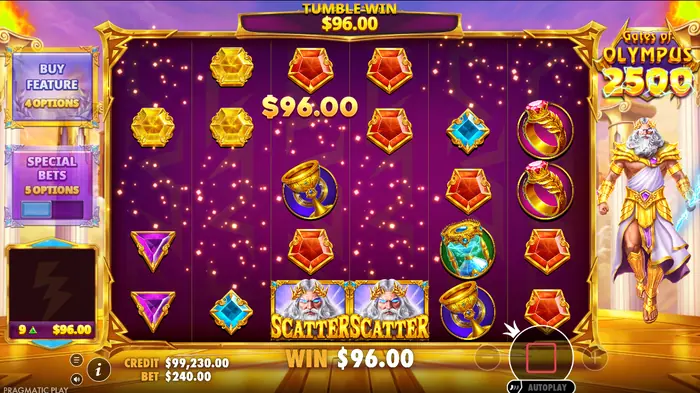
Only the number of Scatters on the screen after a spin matters. 4 or more in any positions, the round starts. The Scatter in Gates of Olympus 2500 is Zeus himself, present on every reel, so there's no need to line them up. At the same time, Scatters pay out: 3x for 4, 5x for 5, 100x for 6 or more.
The exact Scatter count, the number of starting free spins, and the retrigger conditions are best checked in the help screen of the specific game version. Operators sometimes publish the slot with localized tables. The same goes for the min and max bet: this article lists the $0.20–$240 range for the base game, but an operator's version can differ.
Why Bonus Buy Isn't an Income Strategy
Buy Feature looks like a way to "get to the bonus right now." That's the most common trap. The buy price is simply a larger one-time bet. Free Spins 2 at 250x means paying 250 base stakes for a single bonus round. If the round returns less than that, the balance shrinks exactly as it would after a string of empty spins in regular play.
Super Free Spins 2 at 1250x is even larger. At a $1 base stake that's $1,250 for one round; at $240, $300,000. The buy's 96.50% RTP means the buyer loses 3.5% of the cost on average. "On average" only works across many buys, not on a single one.
Buying makes sense as a way to see a bonus round without waiting, not as a way to make money. The decision to buy should sit inside the same budget as a regular session: if 1250x the stake is more than you're willing to lose on a single round, don't buy.
Demo Mode as a Way to Learn the Mechanics
Gates of Olympus 2500's demo mode is useful for exactly what it's built for: learning the buttons, watching a cascade, seeing how multipliers behave, how free spins trigger, and which round type shows up. It's a learning tool. Test sessions are too short to draw conclusions about probabilities or expected returns.
A player who runs 200 spins in demo and catches a bonus doesn't get a statistical edge over one who doesn't. Demo results are just as random as real-money results, and RTP works the same way. The only difference is that the stakes are virtual, and the losses don't register.
Demo is a good fit for:
- understanding how the screen changes when a Scatter lands;
- seeing the difference between the base game and the Ante/Super Spin modes;
- practicing stopping a session by limit instead of by emotion;
- comparing the paytable with how cascades actually play out.
If the operator offers a demo version, starting there is the smarter move. It costs nothing and helps avoid mistakes once real money is on the line. For more, see the guide to demo play for learning the rules.
Practical Checklist Before a Session
- Check the slot version's RTP: the base game in Gates of Olympus 2500 returns 96.52%, with Ante it drops to 96.49%, and Super Spin and bonus buy come in at 96.50%. If the operator shows a different RTP, ask which slot version is actually live.
- Set a budget from money you can afford to lose, and don't go past it.
- Lock in a bet size and a time limit before the first spin: say, 300 spins or 45 minutes, whichever comes first.
- Set a loss limit (for example, 50% of the budget) and a win target at which the session also ends.
- Turn off autoplay if there's any risk of losing track of time, or run it with a pre-set number of spins.
- Stop the moment any limit is hit.
- Don't buy a bonus if its price exceeds the bet size you're comfortable losing in one round.
Common Player Mistakes
- Doubling the bet after a loss. It doesn't speed up the bonus or recover anything; it's just a larger bet on the next random spin.
- Thinking Scatter is "due." After a long run without Scatter, the odds of it landing on the next spin are the same as they were on the previous one.
- Anchoring on someone else's big win. Other players' screenshots with large amounts are individual moments, not the norm for the slot.
- Confusing demo and real money. In demo, losses don't register, which is fine for learning, but decisions in real play need to be tied to a real budget.
- Buying a bonus without checking the price. Buy Feature runs at 100x / 250x / 500x / 1250x of the base stake, a one-time large outlay, not a guarantee of a return.
- Playing with money earmarked for other expenses. A slot is entertainment, not a way to fix financial problems.
Responsible Play and Help
Play is restricted to adults 18 and over. Gambling isn't a source of income and can cause financial harm. Outcomes are random; losses are real. If the game starts taking more time or money than planned, if frustration shows up after a loss, or if the urge to "win it back" kicks in, those are early signs of losing control.
At that point, it's worth stopping play, using the casino's limit tools (daily cap, self-exclusion, account block), and reaching out to a local support service if needed. In the UK, GamCare and GambleAware run national helplines. In the US, the National Council on Problem Gambling (1-800-522-4700) and Gamblers Anonymous offer help. Canadian players can contact the Responsible Gambling Council. Australian players have Gambling Help Online (1800 858 858). Players elsewhere can find regional organizations listed on the operator's site.
Support is free, anonymous, and doesn't come with any obligation to keep playing.
FAQ
Can a strategy help you win at Gates of Olympus 2500?
No strategy can change the outcome of a spin; the random number generator decides that. What's reasonable to call a "strategy" here is a session plan: a budget of money you can afford to lose, a bet size, loss and time limits, and a choice between the base game and the Ante/Super Spin modes. Such a plan doesn't raise the odds of winning, but it caps the size of the losses and helps you stop on time.
What's the RTP of Gates of Olympus 2500, and which mode is best?
The base RTP is 96.52%. With Ante Bet 1, 2, and 3, RTP drops to 96.49%, while Super Spin 1 and 2 and any of the four free-spin buys sit at 96.50%. The base game has the highest RTP. Plain unenhanced play is mathematically better than the upgraded modes.
What does 2500 in the Gates of Olympus 2500 name actually mean?
2500x is the maximum value on a single multiplier symbol. The maximum payout for an entire round is capped at 25,000x the stake. Once that threshold is reached, the round ends immediately, the payout is paid out, and any remaining features are forfeit. Two different numbers that are easy to mix up: 2500x describes the ceiling for one symbol, 25,000x is the ceiling for the whole round.
Is it worth buying the bonus in Gates of Olympus 2500?
Buy Feature costs 100x / 250x / 500x / 1250x of the base stake for Free Spins 1, Free Spins 2, Super Free Spins 1, and Super Free Spins 2 respectively. That's a one-time large bet, not a guaranteed return: the buy's RTP is 96.50%, and the bonus can end with any result, including no profit. Buy only with an amount whose loss wouldn't dent the session budget.